


Healing begins when you feel safe, seen, and supported.
If you’ve started researching trauma therapy, you’ve likely run into two names again and again: Brainspotting and EMDR. Both are real, evidence-informed paths out of the freeze, overwhelm, or emotional static that trauma leaves behind.
You don’t need a clinical degree to choose between them. You just need to understand what each one actually does, and how your own nervous system tends to respond.
Maybe you’re here because talk therapy has helped, but something still feels stuck. Maybe certain memories surface at the worst times, or your body reacts before your mind even catches up. That’s not a flaw in you. It’s often a sign that trauma is being held somewhere talk alone can’t quite reach.
Key Takeaways
- Brainspotting uses a fixed eye position to access and release trauma stored in the subcortical brain, often with little verbal detail required.
- EMDR uses guided eye movements (bilateral stimulation) in a structured, eight-phase process to reprocess a specific traumatic memory.
- Neither is “better.” The right fit depends on your nervous system, your comfort with structure, and whether you find it easier to process trauma somatically or narratively.
- At InDepth Therapy, several clinicians are trained in both, so the choice doesn’t have to be yours to make alone.
What Is Brainspotting?
Brainspotting is a body-based approach to trauma recovery. It was developed in 2003 by Dr. David Grand, who noticed that certain eye positions seemed to unlock stuck emotional material that talk therapy couldn’t reach.
The core idea: where you look affects how you feel. By holding your gaze on a specific point in your visual field, a “brainspot,” your therapist helps you access the subcortical brain, the deeper, non-verbal region where the nervous system stores unprocessed trauma. The Brainspotting Trainings Institute’s own research archive tracks a growing body of case studies and outcome data on this mechanism.
What a session feels like:
- Your therapist helps you locate a brainspot connected to a specific feeling or memory.
- You hold that gaze while your brain does the work of scanning and releasing.
- You don’t need to talk through every detail. Brainspotting works even when words aren’t available yet.
- Sessions tend to feel more intuitive and less structured than traditional talk therapy.
This makes Brainspotting especially gentle for people carrying complex trauma, childhood wounds, or memories that feel too big, too early, or too fragmented to narrate out loud.
What Brainspotting is not: it isn’t hypnosis, and you don’t lose awareness or control during a session. You stay fully present. You’re simply allowing your brain to do what it already knows how to do, given the right conditions.
Sessions are typically spaced a week or two apart, though this is tailored to your pace and what you’re processing. Some people notice a shift in a single session. Others need more time, and that’s expected, not a sign anything is going wrong.
Our Brainspotting therapy page walks through what a first session looks like at InDepth.
What Is EMDR?
EMDR (Eye Movement Desensitization and Reprocessing) is one of the most well-researched trauma therapies available. It was developed by Dr. Francine Shapiro in the late 1980s and has since been recognized by major health organizations worldwide, including the U.S. Department of Veterans Affairs’ National Center for PTSD.
The core idea: bilateral stimulation, typically guided eye movements, helps your brain reprocess a traumatic memory so it no longer carries the same emotional charge.
What a session feels like:
- Your therapist follows a structured, eight-phase protocol: history-taking, preparation, assessment, desensitization, installation, body scan, closure, and reevaluation.
- You’ll identify a specific target memory and the negative belief attached to it (“I’m not safe,” “It was my fault”).
- While holding that memory in mind, you follow the therapist’s guided eye movements or another form of bilateral stimulation.
- Over time, the memory becomes less charged, and a more adaptive belief takes its place.
EMDR’s structure can feel reassuring if you like knowing exactly what’s coming next in a session, and it has a long track record for single-incident trauma like accidents, assaults, or specific frightening events.
What EMDR is not: it’s not a quick fix, and it’s not only for combat veterans or catastrophic events. It’s used for anxiety, panic, grief, and everyday distressing memories too, not just textbook PTSD.
A full course of EMDR usually involves multiple sessions rather than a single breakthrough visit. Progress is measured in how much emotional charge a memory carries when you bring it to mind, not in whether the memory disappears entirely. The goal isn’t to forget what happened. It’s to remember it without your body reacting as though it’s happening right now.
Brainspotting vs. EMDR: The Key Differences
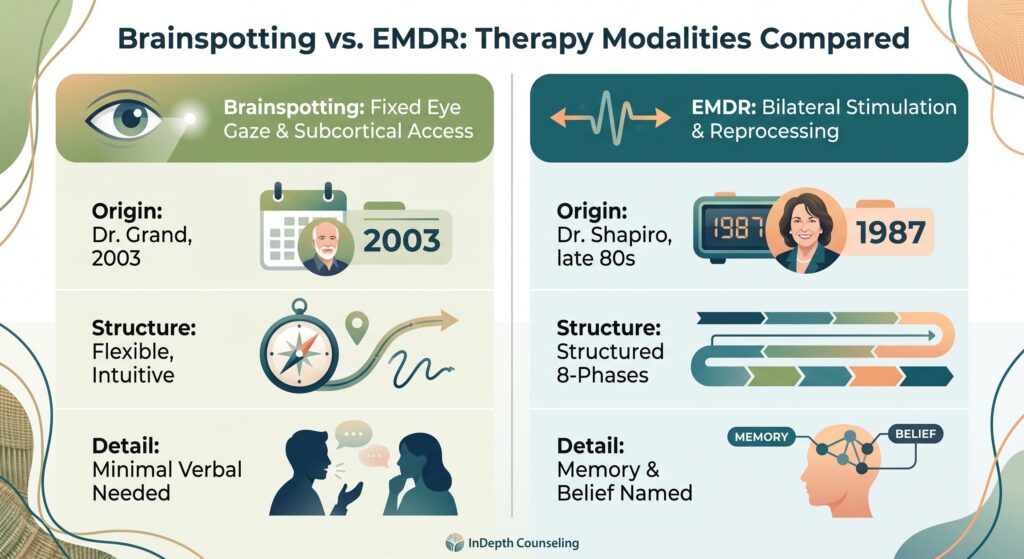
| Brainspotting | EMDR | |
| Origin | Developed 2003, by Dr. David Grand | Developed late 1980s, by Dr. Francine Shapiro |
| Mechanism | Fixed eye position, subcortical access | Bilateral stimulation (eye movements, tapping, sound) |
| Structure | Flexible, intuitive, unfolds in the moment | Structured eight-phase protocol |
| Verbal detail needed | Minimal, can process without narrating the memory | Moderate, memory and belief are named directly |
| Best-known strength | Complex, developmental, or hard-to-articulate trauma | Well-defined, single-incident traumatic memories |
| Evidence base | Growing research, strong clinical outcomes reported | Extensive, decades of randomized controlled trials |
Neither approach requires you to relive trauma in graphic detail against your will. Both are designed to be paced by you, with a trained clinician guiding the nervous system gently rather than pushing it.
On the research question: EMDR has the deeper research library, including decades of randomized controlled trials and endorsement from major psychiatric bodies. Brainspotting’s evidence base is younger but growing, with clinical outcomes often described as comparable, particularly for trauma that resists a purely narrative approach. A peer-reviewed comparative study published via the National Institutes of Health found that both EMDR and Brainspotting produced significant reductions in distress from difficult memories, with outcomes holding steady at follow-up. Neither track record means one is “unproven.” It means one has simply had more time to accumulate formal studies.
On client experience: people processing Brainspotting often describe more physical sensation, a wave of emotion, tension releasing from the shoulders or chest, without always understanding why. People in EMDR more often describe a shift in the story they tell themselves about what happened. Neither experience is more “correct.” They’re just different doors into the same room.
Which One Is Right for You?
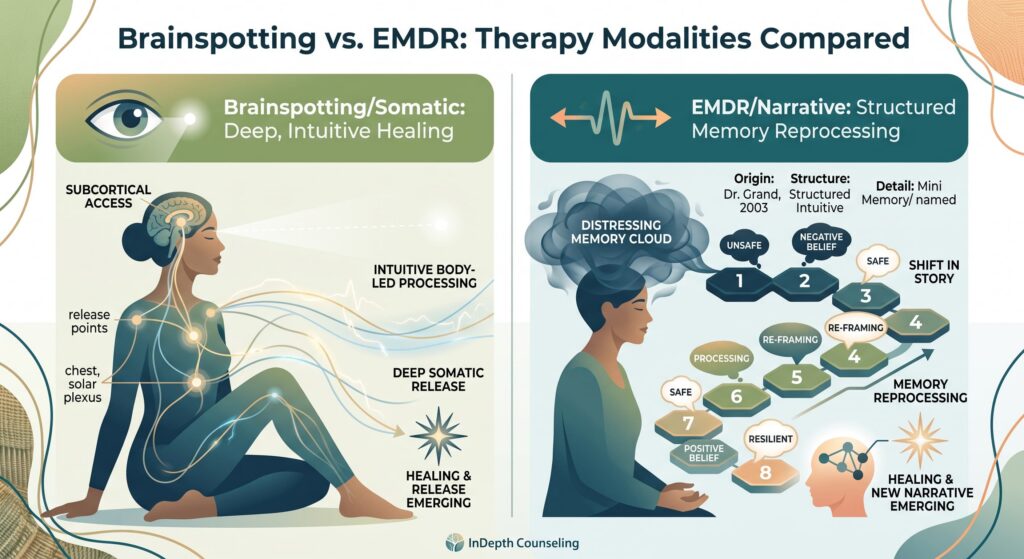
Brainspotting may be a good fit if you:
- Struggle to put certain memories or feelings into words
- Have complex or developmental trauma with no single “incident” to point to
- Feel most at ease with an unstructured, body-led process
- Have tried talk therapy and felt like something deeper was still unreachable
EMDR may be a good fit if you:
- Have one or a few specific, identifiable traumatic memories
- Feel more grounded when a process has clear steps
- Are managing PTSD symptoms like flashbacks, nightmares, or hypervigilance
- Want a therapy with decades of formal research behind it
You may not have to choose at all. Many people benefit from a blend of both, depending on what a given week or session calls for. This is one reason InDepth trains clinicians in both modalities rather than assigning clients to just one lane.
How InDepth Therapy Approaches Brainspotting and EMDR
This isn’t a choice you have to make from a search engine. At InDepth Therapy, Brainspotting is a specialty of Co-Founder Bethany Blankenheim, LPC, ADHD-CCSP, CACII, who has spent 20 years working with complex trauma, grief, and addiction using advanced Brainspotting techniques.
Co-Founder Barbara A. Humble, LCSW, VAT, brings Advanced EMDR and Advanced Brainspotting together with vibroacoustic and hypnotherapy approaches for clients working through developmental trauma and mood disorders that haven’t responded to standard treatment.
Several other clinicians on our team, including Sally A. Morgan, LPC, are trained in both EMDR and Brainspotting. That means your first conversation isn’t about picking a modality in the dark. It’s about naming what you’re carrying, and letting a trained clinician help match the tool to your nervous system.
This dual training matters more than it might seem. A therapist who only offers one modality has one tool for every kind of trauma that walks through the door. A therapist trained in both can shift mid-course, starting with the structure of EMDR and moving into the openness of Brainspotting, or the reverse, based on what your nervous system actually needs that day rather than what the intake form assigned you three months earlier.
Whether you’re closer to our Broomfield headquarters or the Fort Collins clinic, this same standard of care applies. Trauma-informed practice isn’t a specialty reserved for one location. It’s woven through how our whole team, including our master’s-level interns training under close supervision, approaches every client relationship.
If Brainspotting or EMDR doesn’t turn out to be the right fit, it’s worth knowing they’re not the only nervous-system-based tools we offer. Our neurofeedback and brain mapping page covers a related, non-invasive option some clients use alongside or instead of trauma-focused talk therapy.
If you’re not sure where trauma work fits into your broader care, our individual therapy page offers a lower-pressure starting point.
Frequently Asked Questions
Is Brainspotting or EMDR more effective for PTSD? Both have shown meaningful symptom reduction for PTSD. EMDR has a longer research history, while Brainspotting is gaining a growing evidence base for similar outcomes, particularly when clients struggle to verbalize their trauma.
Can Brainspotting and EMDR be used together? Yes. Many trauma-informed clinicians, including several on our team, are trained in both and will move between them based on what a particular memory or session calls for.
Does Brainspotting or EMDR require talking about my trauma in detail? EMDR asks you to identify a specific target memory and belief. Brainspotting requires far less narrative detail and can process material your nervous system hasn’t found words for yet.
How many sessions does Brainspotting or EMDR typically take? This varies by person and history. Single-incident trauma often responds within a handful of sessions, while complex or developmental trauma may take longer with either approach.
Do I need a referral to start Brainspotting or EMDR therapy in Broomfield or Fort Collins? No referral is required. You can reach out directly to schedule an initial conversation with a clinician trained in Brainspotting, EMDR, or both.
Will my therapist decide for me which approach to use? You and your clinician decide together. A good first session usually includes a conversation about your history, your comfort level, and which approach seems like the better starting point, with room to adjust as you go.
Is Brainspotting or EMDR covered by insurance? Coverage depends on your plan. InDepth Therapy accepts a range of major insurance networks, and our team can help you understand your specific benefits before your first appointment.
How is Brainspotting different from neurofeedback? Brainspotting is a talk-and-eye-position therapy guided in real time by a clinician, while neurofeedback trains your brainwave patterns using sensors and real-time feedback. Some clients use both as complementary parts of a broader trauma-recovery plan.
A Gentle Next Step
You don’t need to have this all figured out before you reach out. Understanding the difference between Brainspotting and EMDR is simply the first step toward finding what actually helps your nervous system settle.
If you’re in Broomfield, Fort Collins, or anywhere in Colorado and ready to talk it through with someone who can help you choose, connect with our team. There’s no pressure, just a conversation about what root-cause, whole-person care could look like for you.
About the reviewer: Bethany Blankenheim, LPC, ADHD-CCSP, CACII, is Co-Founder and Clinical Supervisor at InDepth Therapy, with 20 years of experience in Brainspotting, complex trauma, and addiction recovery.
This article is for educational purposes and isn’t a substitute for individualized clinical care. If you’re currently in crisis or having thoughts of harming yourself, please call or text 988 to reach the Suicide & Crisis Lifeline, or go to your nearest emergency room.


