


This article is for informational purposes only and does not constitute medical advice, diagnosis, or treatment. For support with your specific situation, please consult a licensed mental health professional.
There’s a particular kind of exhaustion that settles in when two people who love each other can’t seem to stop hurting each other. Maybe it’s the same argument that shows up every few weeks wearing a different disguise. Maybe one of you has gone quiet. Not out of peace, but because saying anything at all feels like it might break something that’s already fragile. Or maybe things aren’t terrible, exactly. Just distant. Like you’re sharing a life but not quite sharing it with each other.
If any of that feels familiar, you haven’t missed your chance to change it.
Couples therapy isn’t reserved for relationships on the edge. It’s for any two people who want to understand each other more honestly, communicate better, and build something that actually holds. This article walks through what couples therapy looks like at InDepth Therapy in Broomfield, who it tends to help, what the research says about how it works, and how to know when it might be time to reach out.
What couples therapy actually is — and what it is not
Couples therapy is a structured, evidence-based process in which a licensed therapist works with two partners to help them understand and change the patterns driving disconnection, conflict, or stagnation in their relationship.
Worth unpacking, because what couples therapy is not matters just as much.
A couples therapist is not a referee. They’re not there to determine who’s right, validate one partner’s complaints over the other’s, or deliver a verdict on whether the relationship is worth saving. The therapist’s job is to help both partners slow down enough to see what’s actually happening under the surface of their conflicts, then start doing something different.
Couples therapy is also not a last resort. Many couples come in because they want to get ahead of problems before they compound. Others come to deepen a relationship that’s functioning but not fully alive. Neither of those is the wrong reason to show up.
Sessions typically run 50 to 60 minutes. Both partners are heard. Nobody gets ganged up on. The trust that builds between the couple and their therapist is part of what makes the work effective in the first place.
Why couples get stuck: the pattern underneath the pattern
Most couples who come to therapy aren’t struggling because they don’t love each other. They’re struggling because they’ve gotten locked into a cycle. A predictable sequence of moves and countermoves that both partners feed, often without realizing it.
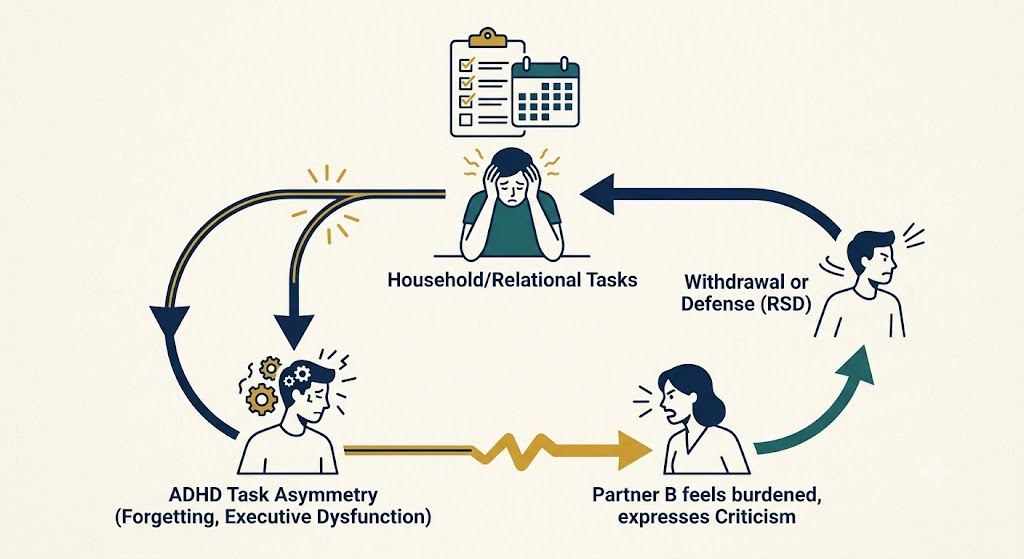
Here’s how it typically goes: Partner A feels disconnected and expresses that through criticism or pursuit. Partner B, feeling blamed or overwhelmed, withdraws. Partner A reads that withdrawal as confirmation of the disconnection and pushes harder. Partner B pulls back further. The content of their arguments changes (money, parenting, household tasks, intimacy) but the underlying dance stays the same.
Attachment science helps explain why. When researchers Cindy Hazan and Phillip Shaver extended attachment theory to adult romantic relationships in the 1980s, they found that the same motivational system governing the bond between infants and caregivers also runs adult partnership, including the need for a felt sense of security and what happens when that security gets threatened. When we feel our partner is available and responsive, we stay open and flexible. When we sense that security fraying, we activate protective patterns that often push them further away.
Unresolved trauma can make all of this worse. When one or both partners carry trauma, it tends to heighten the sensitivity of the cycle and make it harder to step out of it without help. At InDepth Therapy, our clinicians are trained in Brainspotting therapy and other trauma-informed approaches that can work alongside couples sessions when that’s part of the picture.
The goal of couples therapy isn’t to eliminate conflict. It’s to make conflict productive rather than corrosive, and to help both partners feel safer reaching toward each other instead of away.
What emotionally focused therapy (EFT) offers couples
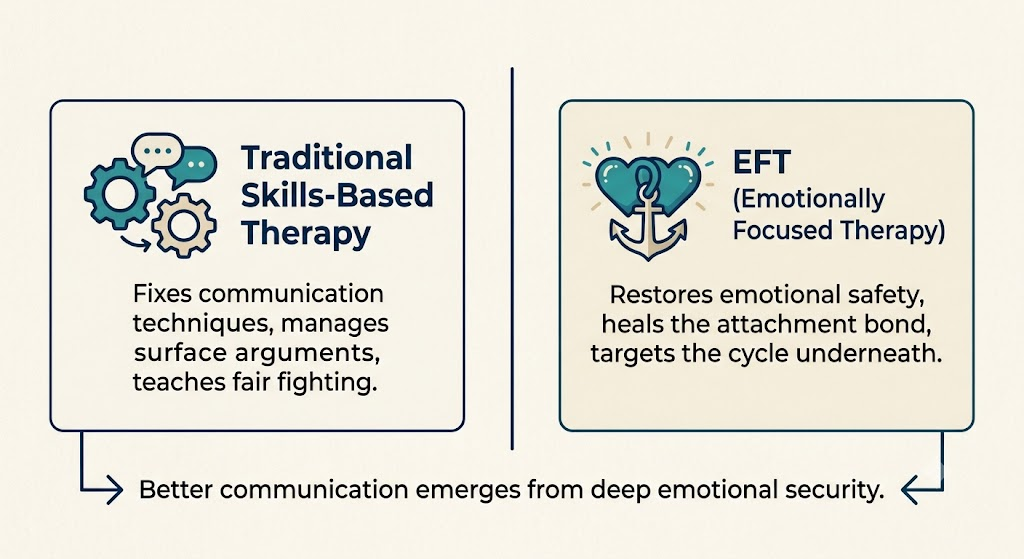
Emotionally Focused Therapy was developed by Dr. Sue Johnson in the 1980s. It’s now one of the most thoroughly researched couples therapy approaches in the world, and it works by targeting the attachment patterns underneath relational distress, not just the surface behaviors.
Some couples approaches focus primarily on communication skills: better listening, de-escalation techniques, learning to fight fair. EFT goes a layer deeper. The premise is that most relational problems aren’t really about communication. They’re about emotional safety. When partners feel securely connected, communication tends to get better on its own. When that safety breaks down, even solid communication skills often don’t hold.
The American Psychological Association recognizes EFT as an evidence-based approach that works by transforming negative emotional and interactional patterns into healthier cycles of bonding and validation. EFT sessions move through three broad phases: identifying and slowing down the negative cycle both partners are caught in; helping each person access and express the deeper emotions and needs underneath their typical reactions; and building new patterns of interaction where both partners feel more emotionally accessible to each other.
The research is worth knowing. A meta-analysis published in Psychotherapy Research, covering 33 randomized controlled trials and 2,730 participants, found EFT produced medium-to-large effect sizes on relationship satisfaction. The International Centre for Excellence in Emotionally Focused Therapy summarizes the landmark early research (Johnson et al., 1999): 70 to 73% of couples who completed EFT moved from relational distress to recovery, with those results holding up at follow-up. Studies have also shown EFT works well for couples where one partner is dealing with depression, trauma, or chronic illness.
At InDepth Therapy in Broomfield, Barbara A. Humble, LCSW, who brings over 30 years of clinical experience, works with couples using both EFT principles and neuroscience-informed approaches. The team’s depth means the work isn’t templated. It gets shaped to what each specific partnership actually needs.
Who couples therapy helps
Couples therapy isn’t only for relationships in crisis. A 2021 study in the Journal of Marital and Family Therapy found that couples waited an average of 2.68 years from the start of serious problems before seeking help, and that most who did seek help came within the first two years. The study’s authors concluded there is “little reason to be pessimistic” about outcomes based on how long someone waited. Below is a realistic picture of who tends to come in, and why.
Couples experiencing repeated conflict. Same argument, different packaging. The topics rotate (money, parenting, intimacy, household responsibilities) but the emotional shape never changes. Neither person feels heard. Nothing resolves. Structured therapy shifts the focus from the content of each fight to the cycle driving them all.
Partners who have grown distant. Not fighting so much as drifting. More like roommates than partners. EFT’s emphasis on emotional reconnection tends to land well here, particularly when both people still care but have stopped reaching toward each other.
Couples working through a specific rupture. An affair, a serious breach of trust, or a major event that one partner handled in ways that left the other feeling alone. These situations often require a structured repair process that’s hard to build without a third party in the room.
Newlyweds and pre-committed couples. Prevention-focused couples work is underused and genuinely useful. Building good relational habits before patterns calcify is much easier than trying to change them after years of reinforcement.
Parents and blended families. Parenting puts pressure on even solid relationships. When that stress spills beyond the couple into the broader household, our family therapy in Broomfield can run alongside couples work.
Couples where one or both partners are neurodivergent. ADHD, in particular, has a predictable effect on relational dynamics: emotional regulation, task asymmetry, sensitivity to criticism, difficulty with transitions. These patterns benefit from a therapist who understands how neurodivergence and attachment interact.
InDepth Therapy is explicitly LGBTQ+ affirming. We work with couples and partnerships of all configurations, identities, and relationship structures. Sometimes the most useful step alongside couples work is individual support for one or both partners. Our individual therapy in Broomfield and Fort Collins is available as a parallel or separate part of the process.
What to expect in your first few sessions
What keeps most couples from reaching out isn’t doubt about whether therapy could help. It’s not knowing what they’re actually walking into. Here’s an honest picture.
The first session is typically a joint intake. Your therapist will want to understand both partners’ experience of the relationship, what brought you in now, and what you’re both hoping for. You’ll share. But you’ll also be heard. A good couples therapist tracks both of you from the first session.
Early sessions build a picture of the relationship’s history, the patterns that have formed, and what each person brings from their own background. Your therapist may ask about family of origin, past relationships, what drew you to each other. That’s not tangential. It’s the whole point.
By the third or fourth session, most couples start to actually see their cycle. That moment of recognition (“oh, that’s what we keep doing”) is itself therapeutic. It moves the dynamic from two people at odds to two people looking at a shared problem together.
Most couples who work consistently see real change within three to six months. Relationships with more complexity (serious trauma, a major breach, long-established patterns) usually take longer. The pace is always set with you, not for you.
Signs it might be time to reach out
There’s no minimum level of bad that has to be reached before couples therapy makes sense. But here are some of the things that tend to bring people in:
- You have the same argument in different forms. The topics change. The emotional shape doesn’t. Neither person feels heard. Nothing gets resolved.
- One of you has gone quiet. Not because things are fine, but because speaking up has started to feel pointless or risky. Withdrawal usually means emotional safety has eroded.
- You feel more like roommates than partners. The logistics work. The connection doesn’t. You’re managing a shared life but have stopped really reaching toward each other.
- A specific event shook the foundation. An affair, a breach of trust, or a crisis that one partner handled in ways that left the other feeling alone.
- A major transition is coming. A new baby, a job change, a move, a loss. These stress even solid relationships. Getting support before the pressure builds is easier than trying to repair after.
- One partner has asked to try therapy. When one person is asking, that’s enough. It doesn’t require mutual urgency to be worth taking seriously.
You don’t have to be in crisis. The couples who tend to do best are often the ones who came in before things got worse, not because they were falling apart, but because they decided to pay attention before it got to that point.
Frequently asked questions
Does couples therapy actually work?
The research says yes, for most couples who complete it. A meta-analysis of 33 randomized controlled trials found medium-to-large effect sizes for both EFT and Behavioral Couples Therapy on relationship satisfaction. For EFT specifically, the International Centre for Excellence in EFT cites research showing 70 to 73% of couples move from distress to recovery, with those gains holding at follow-up. Results depend on both partners’ engagement and what’s being worked on, but EFT’s evidence base is among the strongest of any couples approach.
How long does couples therapy take?
Most couples who work consistently see real change within three to six months. Those working through more complex histories (serious trauma, a major breach of trust, patterns built over many years) typically need nine to twelve months or more. Your therapist will check in regularly on progress. There’s no fixed endpoint.
What’s the difference between EFT and Gottman Method couples therapy?
Both are evidence-based and well-studied. EFT works primarily at the level of attachment bonds and emotional safety. The goal is to help partners get to the deeper feelings underneath their typical reactions, and to rebuild the sense of security between them. The Gottman Method focuses more on communication patterns, conflict management, and specific skill-building. EFT tends to fit better when emotional disconnection and attachment anxiety are at the center; Gottman can be a strong fit when couples benefit from concrete tools and structured communication practice. At InDepth, the approach is EFT-based, with trauma-informed clinical practice woven throughout.
Do both partners have to attend every session?
Joint sessions are the standard format, because the relational dynamic is what’s being worked with and the therapist needs both people present to do that. Some therapists build in occasional individual sessions, particularly when one partner is processing something that benefits from separate space. At InDepth Therapy, individual therapy can run alongside or alternate with couples work, depending on what fits.
Can couples therapy help if one partner is reluctant?
Yes, though it works better when both partners show up willing to try. A good couples therapist can work with skepticism directly, in session. Reluctance isn’t disqualifying. What matters is presence and a willingness to give it a fair shot. A lot of initially reluctant partners report that the first two or three sessions shifted how they were thinking about it.
Couples therapy in Broomfield with InDepth Therapy
InDepth Therapy is a group practice in Broomfield, Colorado, with a second location in Fort Collins. Our therapy and counseling services include individual, couples, family, and teen therapy, alongside ADHD testing and integrative wellness offerings. The clinical team carries training in Emotionally Focused Therapy, Brainspotting, trauma-informed relational work, and neuroscience-informed approaches.
Couples therapy at InDepth isn’t a communication skills course. It’s clinical, attachment-based work led by therapists who understand that what’s driving the arguments is usually something that lives deeper than the arguments themselves.
If you want to understand what working with us would actually look like, reach out to our Broomfield team. You can also visit our couples therapy services page to read therapist profiles and get a clearer sense of the intake process.
You don’t have to have it figured out before you call. That’s what the first conversation is for.
InDepth Therapy serves couples in Broomfield, Thornton, Westminster, Arvada, Louisville, Boulder, and the greater Denver metro area. Telehealth services are available throughout Colorado.


